- When bringing your hand and arm up into bong sau, you need to be moving both upwards, forwards and inwards towards the centre simultaneously. A good way to do this is to imagine your elbow tracing an arc through the air from start to end point.
- When moving from bong sau to tan sau when rolling, move into fook sau first, and then roll your wrist over. This will stop your hand from dropping and will leave your hand on the centre line.
Showing posts with label Wing Chun. Show all posts
Showing posts with label Wing Chun. Show all posts
Thursday, March 08, 2007
Wing Chun: Bong Sau Tips
Today my class was visited a very talented high level instructor. Although he only spent a few minutes looking at my bong sau, he gave two invaluable tips:

Tuesday, December 12, 2006
Chark Jong - The Calm in the Eye of the Storm
Doing Chark Jong (breaking of the guard) today, my instructor pointed out that I was tensing up too much, and comitting myself to a big forward rush, when I should have been simply walking forward in my correct stance. After this and some more demonstation, I had an ephinany and things suddenly clicked. Here is my summary of how to do the technique more correctly:
- Put on a correct stance.
- Imagine yourself being sucked up towards the ceiling head first, or that your body is suspended from a thread going from the top of your head to the ceiling. This will straighten your back and neck and relax your spine.
- Mirror your oponent's guard with your guard.
- Imagine your arms are very heavy, and relax all the muscles in your arms and shoulders. Your arms should be rotated up and forward by your shoulder ball joint, holding the ultimate angle, but otherwise completely relaxed. Your elbows should feel as though they are pointing towards the floor.
- Step forward naturally from your waist.
- As you close with your opponent's guard (preferably a bit above it), allow your arms to drop down under their own weight, while focusing strongly on a point (eg, on the centre of your oponent's chest). Don't stop walking as your do this. The combined forward movement of your body and downward fall of your arms will mean that you collapse your oponents guard and hit through to their chest.
- Pull back both hands with a circular movement driven from your elbow, like in the form. This will catch the remains of your oponent's guard and further disrupt their stance. If this move isn't working for you, don't overdo it - be careful not to come out of your stance.
- Finish by stepping foward from the waist (imagine your belly button is leading the way) and drive your arms forward in a double palm strike.
Saturday, November 18, 2006
Wing Chun Grading
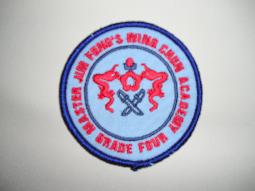 This morning I went for a grading to move from grade 3 to grade 4. I did better than I could have hoped - both passed and got a good score! New and exciting Grade 4 techniques shall be revealed to me next training :-)
Saturday, August 12, 2006
What is Wing Chun About?
For those of you who haven't heard of it, Wing Chun is a type of Kung Fu which was developed by a nun in China, a couple of hundred years ago. It focuses on technique rather than strength and, as such, is designed so that a smaller person can successfully fight a much larger person, and not get too tired out in the process. There's no messing around in Wing Chun, it's not like the movies where fights go on for ages. The aim is to take out your opponent rapidly and effectively.
Here are the principles of Wing Chun, according to the masters:
As a Wing Chun student of about 3 years (ie, by no means an expert), I think this means:
Here are the principles of Wing Chun, according to the masters:
- Economy of movement
- Directness
- Practicality
As a Wing Chun student of about 3 years (ie, by no means an expert), I think this means:
- Carefully angling legs and arms (the ultimate angle) at which point they are very strong and take very little energy to resist force applied by an adversary.
- Applying full body weight in every movement (eg, force going from shoulder, to elbow, to wrist in each movement).
- Relaxation of muscles to increase speed, decrease energy use and make it very difficult for your adversary to grab you.
- Redirection of strikes rather than blocking.
- Increasing force of your strikes through pivoting and stepping forward.
- Simplicity. Movements are simple with no adornments.
- Ruthlessness. Nowhere is off bounds to a strike when you're fighting for your life.
- Keeping your pelvic floor muscles lightly tensed so that your body works as a single unit.
- Every defence is also an attack.
- Stance is very important. From a strong stance, your blows have much more force as you do not move backwards when you strike. All your force goes into your opponent, rather than rocking you backwards.
- Upsetting the stance and breaking the guard of your opponent is a major goal. Once that's done, they are at your mercy, you can keep them off balance by constantly moving forward.
Subscribe to:
Posts (Atom)

